Most home appliances last 10 to 15 years, and gas ranges hold the record among kitchen appliances at closer to 15 to 20. That’s the short version. The longer version matters more, because how long do appliances last depends on which number you’re actually asking about.
Here’s the confusing part. One respected chart lists a refrigerator at 13 years. A European dataset tracking real households puts large appliances near 12 and a half years and rising. Consumer Reports surveys find a large share of refrigerators need service well before either mark. None of those sources made a mistake. They measure three different things, and once you see the difference, every lifespan chart online starts making sense.
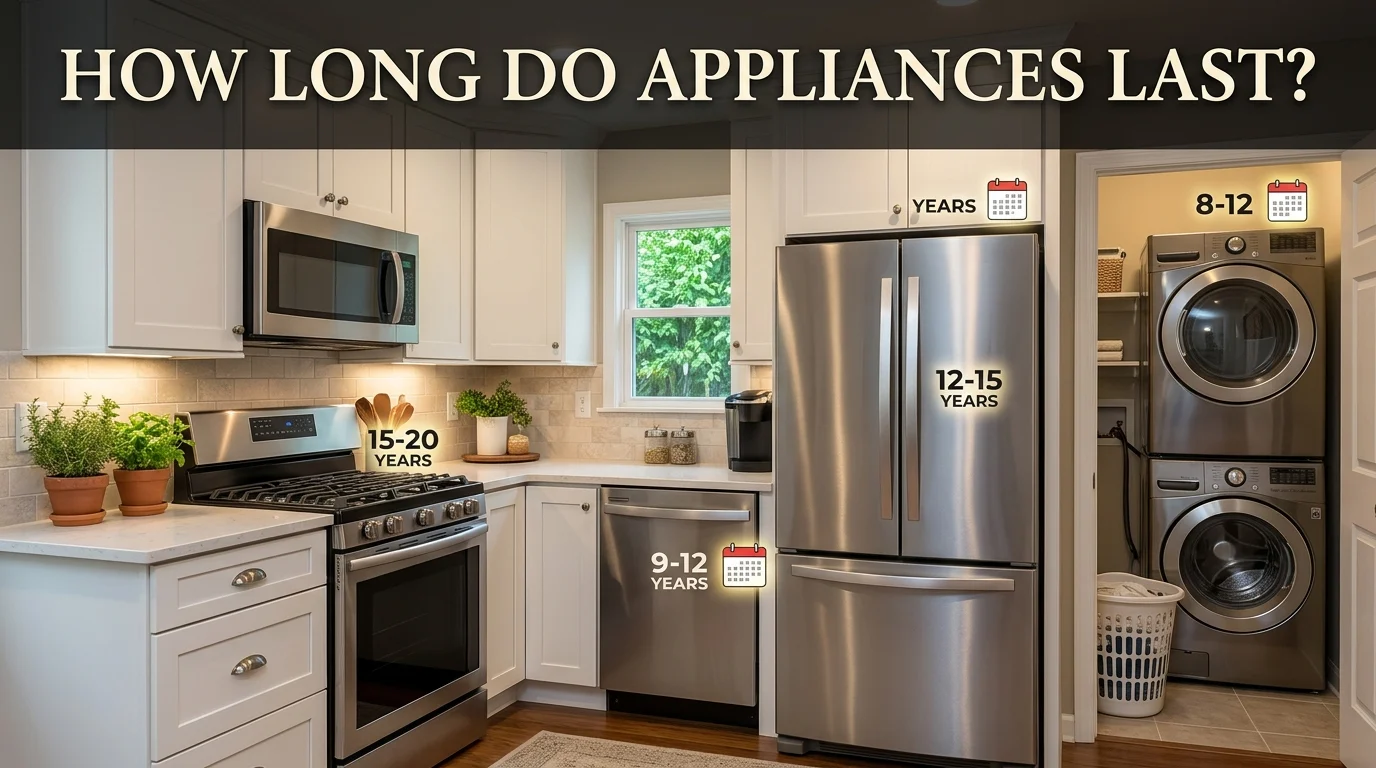
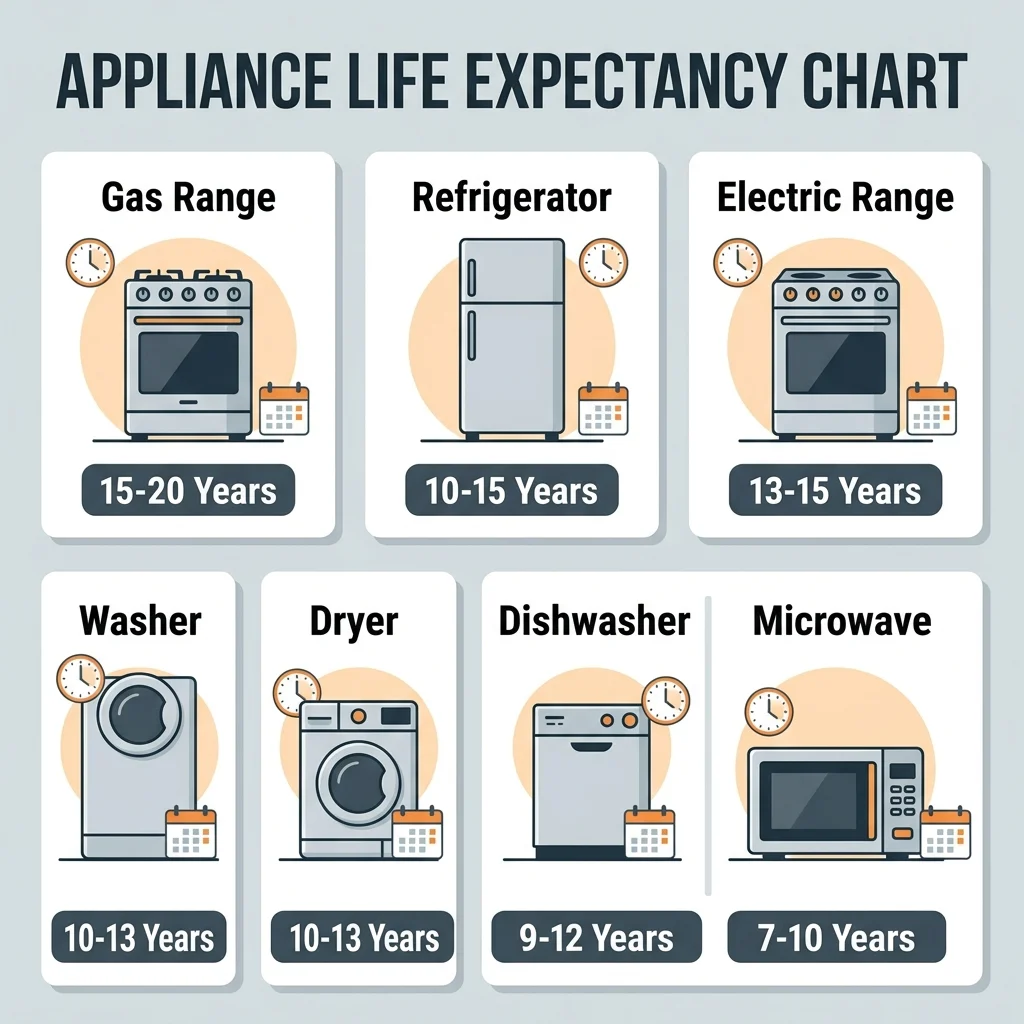
Refrigerators last 10 to 15 years, gas ranges 15 to 20, electric ranges 13 to 15, dishwashers 9 to 12, washers 10 to 13, dryers 10 to 13, and microwaves 9 to 10. Brand tier shifts these by 5 years or more in either direction, and maintenance shifts them again.
Appliance life expectancy chart
| Appliance | Typical life | Budget tier | Premium tier | Part that usually goes first |
| Refrigerator | 10 to 15 years | 8 to 11 | 18 to 25 | Ice maker, then compressor |
| Freezer, standalone | 12 to 20 years | 10 to 14 | 20+ | Thermostat, door seal |
| Gas range | 15 to 20 years | 12 to 15 | 20+ | Igniter, burner valve |
| Electric range | 13 to 15 years | 10 to 13 | 18+ | Control board, heating element |
| Wall oven | 10 to 15 years | 9 to 12 | 18+ | Control board, door hinge |
| Cooktop | 10 to 15 years | 9 to 12 | 18+ | Igniter, glass surface |
| Dishwasher | 9 to 12 years | 7 to 10 | 15 to 20 | Pump, door latch |
| Microwave, countertop | 7 to 10 years | 5 to 8 | 10 to 12 | Magnetron, door switch |
| Washing machine | 10 to 13 years | 8 to 11 | 15 to 20 | Bearings, drain pump |
| Clothes dryer | 10 to 13 years | 9 to 12 | 15 to 20 | Heating element, belt |
| Garbage disposal | 8 to 12 years | 6 to 9 | 12 to 15 | Motor, splash guard |
| Water heater, tank | about 10 years | 8 to 10 | 12 to 15 | Anode rod, tank corrosion |
Typical life figures draw on the InterNACHI Standard Estimated Life Expectancy Chart for Homes, which home inspectors use nationwide. Tier columns reflect the pattern we see in service calls, plus manufacturer published design targets.
Why life expectancy numbers disagree so much
Three different measurements get called “lifespan,” and mixing them causes most of the confusion.
Design life: How many years the machine was engineered to run. Miele publishes a design target of 10,000 operating hours for its washing machines, which the company describes as roughly 20 years of average household use. That’s a manufacturing spec, not a promise about your unit.
Observed replacement age: When people actually swap the machine out. The European Environment Agency tracks this across member states and found large household appliances moved from 11 years 7 months in 2019 to 12 years 6 months in 2023. Notably, that trend points up, not down.
Time to first service call: How soon something breaks, which says nothing about total life. Consumer Reports reliability surveys track this by brand and refrigerator type, and a machine can need a $180 ice maker at year four and still run for another decade.
So a fridge can be “13 years” on an inspection chart, “20 years” in an engineering spec, and “broken” at year four, all at once. Nothing contradicts. The day an appliance dies and the day it stops being worth fixing are also two separate days, usually years apart.
InterNACHI adds a point worth sitting with: people often replace appliances long before they wear out, driven by kitchen remodels, styling and new features. A fair share of “dead” appliances go to the curb still working.
How long does a stove or oven last
Cooking appliances outlast almost everything else in the kitchen. InterNACHI lists gas ranges as the longest lived major appliance in the home, and our service records agree.
Gas range
Expect 15 to 20 years. Fewer electronic parts means fewer failure points. Igniters are the common repair, and a weak igniter shows up as a burner that clicks a long time before catching. That part runs modest money and takes under an hour, so a 14 year old gas range is almost always worth fixing.
Electric range
Plan on 13 to 15 years. Coil elements are cheap and simple. Smooth glass tops and touch control panels shorten the range, since control boards cost real money and get discontinued once a model ages out.
Wall oven
Roughly 10 to 15 years. Hinges sag, door glass loses its seal, and control boards fail more often here than on freestanding units. Heavy use of a self clean cycle stresses the board, since the oven runs extremely hot for hours. Running that cycle once or twice a year rather than monthly buys you time.
Cooktop and induction
Around 10 to 15 years. Induction units often go longer because they have no exposed heating element. Their electronics sit close to the cooking surface, though, so ventilation matters more than most owners expect.
How long do refrigerators last
Typical range: 10 to 15 years, and built in models frequently pass 20.
Ice makers cause a large share of all refrigerator service calls, far more than compressors do. That’s an important distinction, because an ice maker is a repair and a failed sealed system on an older unit usually is not. French door and side by side models with through the door dispensers have more parts, more water lines and more service visits than a plain top freezer, which is the simplest and longest running configuration you can buy.
Two habits add years. Vacuum the condenser coils twice a year, more often with pets in the house. Check the door gasket with a dollar bill: close the door on it, and if it slides out with no drag, the seal is letting warm air in and the compressor is running longer than it should.
How long do washers and dryers last
Both land around 10 to 13 years, and dryers usually outlive washers. A dryer is a heating element, a belt and a motor. A washer manages water, spin balance and bearings, so it has more ways to reach the end.
Front load and top load machines run similar lifespans with different weak spots. Front load door gaskets collect moisture and mildew when the door stays shut between loads. Top load machines with an agitator handle heavy soil well but push more wear into the transmission.
Excess detergent shortens both. Modern high efficiency machines use very little water, so extra soap sits in the tub and stresses pumps and seals. Use the marked line, not the cap.
Dryer vents deserve their own paragraph. Lint blocks airflow, the machine runs longer cycles, the heating element and thermal fuse work harder, and the risk of a vent fire climbs. Clean the lint screen every load, and have the duct cleaned yearly, especially in buildings where the run to the exterior wall is long.
How long does a microwave last
Countertop microwaves last 7 to 10 years. Over the range models often stretch to 10 or 12, partly because they run shorter cycles and double as a vent hood.
The magnetron generates the microwaves, and when it fails the unit heats slowly or stops heating while the light and turntable still work. On a countertop model, a magnetron replacement usually costs more than a new machine. On a built in or over the range unit, repair often makes sense, since replacement means matching a cabinet opening.
Appliance and refrigerator lifespan by brand
Brand changes lifespan more than any other single factor. Price tier tracks it reasonably well, with one caveat worth stating plainly: reliability and lifespan measure different things. A brand can post a low first year service rate and still not reach 20 years, and a brand can need a repair at year five and run past 18.
The budget tier covers builder grade units and entry lines. Expect 7 to 11 years. Thinner components, plastic gears, and parts that get discontinued quickly. Repairs stay cheap while parts remain available, which is often the deciding factor around year eight.
Mainstream tier includes Whirlpool, GE, Frigidaire, Maytag and Kenmore. Expect 10 to 15 years. Whirlpool and GE both post below average service rates in reliability surveys, and their parts stay available for a long time, which quietly extends real world life.
Premium mainstream covers Bosch, LG, KitchenAid, Samsung and Café. Expect 12 to 18 years with better build quality. LG and Bosch score well on early service rates. Samsung refrigerators draw more ice maker and cooling complaints than the category average, and that shows up in our own call volume.
Luxury tier covers Miele, Sub Zero, Wolf, Thermador and Gaggenau. Expect 18 to 25 years. Sub Zero backs its sealed refrigeration systems with a 12 year warranty, which tells you what the company expects from the compressor. Wolf ranges and Thermador cooktops regularly reach 20 years in home kitchens. These units cost more to service, and they earn it back only if you keep them long enough.
One honest caveat on brand data: service rate figures come from regional networks, and a brand with strong local parts and technician coverage looks better in that region than it might nationally. Read brand rankings as a strong signal, not a verdict.
Why modern appliances have shorter lives than old ones
Your grandmother’s range ran 30 years. Three things changed.
Electronic control boards replaced mechanical timers and switches. A board offers precise control and gives the machine a single expensive failure point. Feature count also climbed sharply, and every dispenser, sensor and screen adds another part that can quit. Manufacturers stock parts for a defined window as well, often around 7 to 10 years after a model ends production, so a repairable machine can still become unrepairable.
Materials shifted too. Plastic gears and lighter gauge metals cut weight, shipping cost and price. The upside is real, though: today’s refrigerator uses a fraction of the electricity a 1990 model did, and the European data shows lifespans actually creeping back up.
How to find your appliance’s age
Guessing wastes money. Every major appliance carries a rating tag with a serial number, and that number encodes the build date.
Check these spots: inside the refrigerator on the upper left wall or behind the crisper drawer, inside the dishwasher door on the edge, on the back panel of a washer or dryer, and under the cooktop or inside the oven door frame on a range.
Once you have it, note the brand and serial number and look up that brand’s date code format. Whirlpool, GE and LG each use their own scheme, and the first few characters usually encode a week and year. Knowing the machine is 6 years old instead of 12 changes the repair decision completely.
Repair or replace: a simple rule
Use two tests together.
The 50 percent test. If the repair quote exceeds half the cost of a comparable new unit, replacement usually wins.
The 75 percent test. If the appliance has passed 75 percent of its expected life from the chart above, lean toward replacement even on a cheaper repair, because the next failure is close behind.
Fail both, replace. Pass both, repair without hesitation. Split the difference and consider two more factors: parts availability for that model, and whether the machine is built in. A built in wall oven or a counter depth refrigerator carries installation costs that a freestanding unit does not, which tilts the math toward repair.
Common repairs like an igniter, a dryer heating element, a dishwasher drain pump or a refrigerator ice maker sit well under the 50 percent line on most machines. Sealed system work on a refrigerator, a washer transmission, and a control board on a discontinued model are the ones that usually signal it’s time.
What Brooklyn kitchens do to appliance lifespan
Local conditions matter here more than a national chart suggests.
Apartment sized 24 inch ranges, dishwashers and refrigerators are common across the borough, and they run smaller motors and tighter components than 30 inch units. They also cost less to buy, so the repair math tips sooner.
Older buildings bring their own factors. Kitchens in pre war walkups often have limited outlet capacity and long, awkward dryer vent runs, both of which push appliances harder. Stacked laundry closets restrict airflow around the machines, which raises operating temperature and shortens element and board life. Rooftop water tanks and older building plumbing also leave scale on dishwasher and washer heating elements, and scale acts like insulation, forcing longer cycles.
Delivery access changes the decision too. Getting a new refrigerator up four flights or through a narrow prewar doorway adds real cost and sometimes requires a hoist or a door removal. In those buildings, a $250 repair on a 10 year old machine frequently beats a $1,400 replacement that turns into a $1,900 project.
How to make appliances last longer
Skip the generic advice. These five actions produce the most extra years:
- Refrigerator: vacuum the condenser coils twice a year and test the door gasket with a dollar bill
- Dryer: clean the lint screen every load and have the full vent duct cleared annually
- Dishwasher: pull and rinse the bottom filter monthly, and run hot water at the sink before starting a cycle
- Range: wipe spills off igniters and burner caps promptly, and limit self clean cycles to once or twice a year
- Washer: measure detergent to the line, and leave a front load door ajar between loads
Level matters across all of them. An unlevel washer wears bearings, an unlevel refrigerator strains the door seal, and an unlevel range cooks unevenly.
FAQ
How long do kitchen appliances last?
Kitchen appliances generally last 9 to 15 years. Gas ranges lead at 15 to 20 years, refrigerators run 10 to 15, dishwashers 9 to 12, and microwaves 7 to 10. Premium brands add 5 years or more to each figure.
How long should a stove last?
A gas stove should reach 15 to 20 years, an electric stove 13 to 15. Simple mechanical controls last longer than touch panels. Igniters and heating elements are inexpensive repairs that keep an older stove running well.
What is the lifespan of a refrigerator?
Most refrigerators run 10 to 15 years, and built in models often exceed 20. Top freezer designs typically outlast French door and side by side models because they carry fewer parts and no water dispenser.
How long does a dryer last?
Dryers last 10 to 13 years and usually outlive the matching washer. Yearly vent cleaning is the single biggest factor. Blocked ducts overwork the heating element and create a fire risk.
Which kitchen appliances last the longest?
Gas ranges lead among major kitchen appliances, followed by standalone freezers at 12 to 20 years. Both use straightforward mechanical designs with few electronic controls, which is exactly why they last.
Does brand affect appliance lifespan?
Yes, and by a wide margin. Budget lines average 7 to 11 years while luxury brands reach 18 to 25. Parts availability matters as much as build quality, since a repairable machine still gets retired when parts stop shipping.