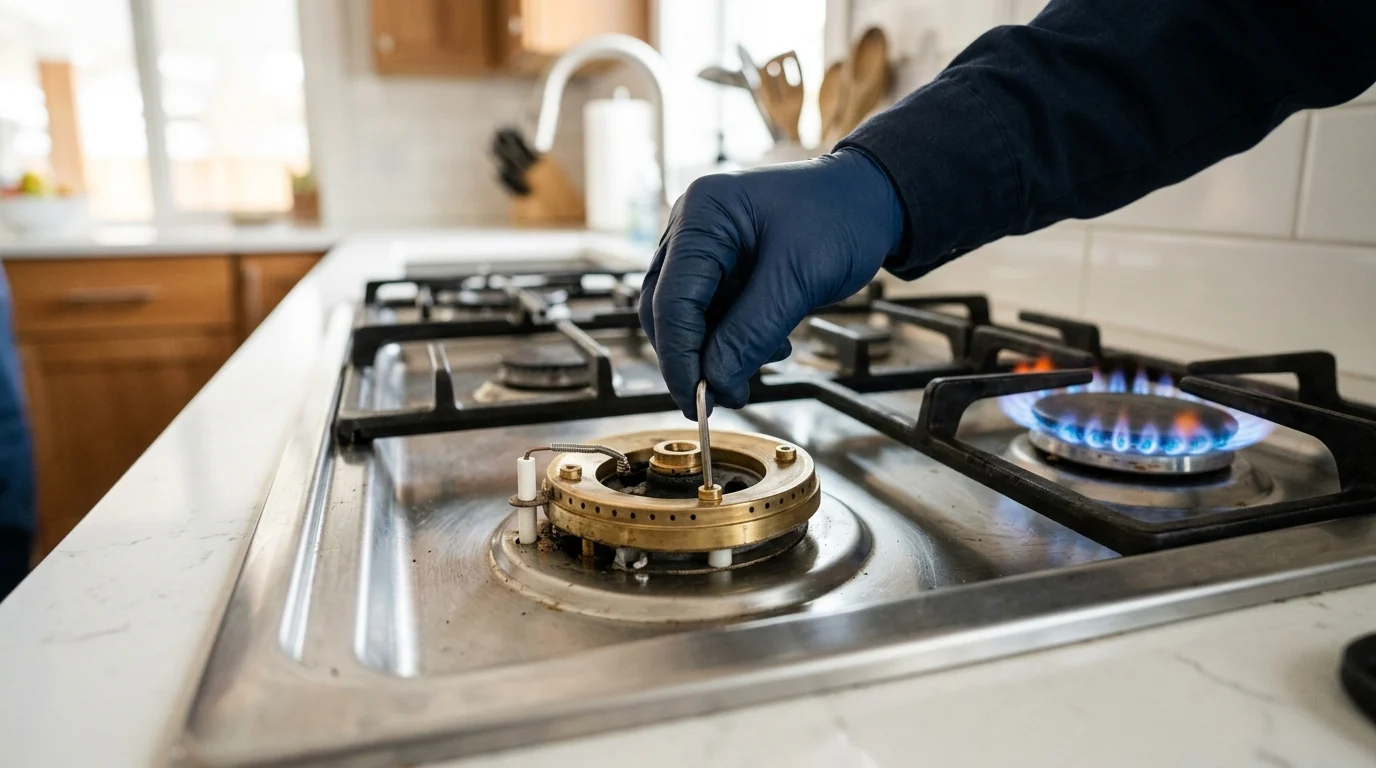
A burner on a gas stove won’t light for one of five reasons. The most common are a clogged port, a misaligned cap, moisture on the igniter, a weak spark, or a gas supply problem. Most of these you can check and fix yourself in under fifteen minutes without touching the gas line.
Before you try anything, do one quick safety check. If you smell gas while turning the knob, stop immediately. Turn off every burner, open a window, and leave the burner alone until a licensed technician looks at it. Never light a match or use a lighter to test a burner that smells like gas.
Once you’re sure there’s no gas leak, work through the sections below based on what your stove is doing.
Is It One Burner or All of Them?
This single question narrows down the cause faster than anything else.
If only one burner won’t light while the others work fine, the problem is almost always local to that burner. Look for a dirty port, a shifted cap, or a worn igniter tip. Jump to the “One Burner Won’t Light” section below.
If every burner on the stove refuses to light at the same time, the issue is upstream of the burners themselves. That usually points to the gas supply, the control board, or a power interruption. Skip ahead to “All Burners Won’t Light.”
One Burner Won’t Light (Most Common Causes)
A gas stove burner won’t light this way more often than any other pattern. It’s also the easiest fault to fix without a technician.
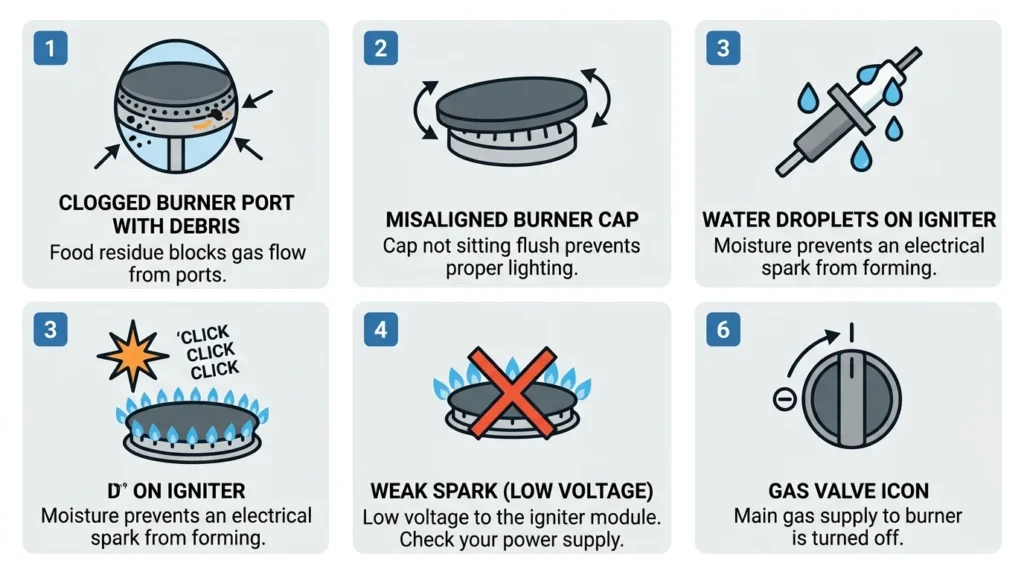
Clogged burner ports. Food splatter, sugar syrup, and grease build up inside the tiny holes around the burner ring. Even a few blocked ports can starve the flame of enough gas to catch. Remove the grate and cap, then look closely at the ring for anything crusted over the holes. Clear each port gently with a straight pin, a toothbrush, or a paperclip. Skip toothpicks; they snap off inside the port and make the clog worse.
A misaligned burner cap. The cap has to sit centered and flush on its base for the spark to reach the gas properly. If it got bumped during cleaning or cooking, it may be sitting slightly off. Lift it off, wipe the base, and set it back down so it seats evenly all the way around.
Moisture around the igniter. This is the exact reason so many people notice a gas stove burner won’t light after cleaning. Water, cleaning spray, or a boiled over pot can leave a thin film on the igniter tip.
An igniter that’s even slightly wet can’t build a strong enough spark. Dry the area with a paper towel, then let the burner air dry for thirty minutes to an hour before trying again. A cool hair dryer on low speeds this up if you’re in a hurry.
Burner Clicks But Won’t Light
If you hear steady clicking with no flame, the igniter is sparking but something is stopping that spark from reaching the gas, or the spark itself is too weak.
A worn igniter throws a dim orange spark instead of a sharp bright blue one, and a weak spark often isn’t hot enough to ignite gas reliably. Dirt or grease coating the electrode tip has the same effect, so wipe it clean with a dry cloth first. If cleaning and drying don’t change anything, the ceramic igniter itself has likely cracked or degraded with age and needs replacing.
Loose wiring behind the control panel can also cause clicking without ignition. That fix involves opening the panel and checking connections, which is worth leaving to a professional unless you’re comfortable working near a stove’s internal wiring.
No Click, No Spark At All
Silence instead of clicking points somewhere else entirely.
Check that the stove is getting power. A tripped breaker or an unplugged unit will kill the igniter system even though gas can still flow. Reset the breaker and try again.
If power is confirmed and you still get no click, the spark module itself may have failed. This small component sends power to each igniter, and once it fails, none of the burners will spark until it’s replaced. That’s a part swap best handled by an appliance technician, since it usually means partially disassembling the control panel.
All Burners Won’t Light
When every burner is dead at once, look past the burners and check the gas supply first.
Confirm the gas shutoff valve behind the stove is turned fully to the “on” position; it’s easy to bump closed while cleaning or moving the range. Check the supply line for obvious kinks. If you can smell gas anywhere near the connection, shut the valve and call a professional immediately rather than investigating further yourself.
If the supply checks out fine, a whole stove electrical fault, a failed control board, or a main power interruption is the likely cause. These sit beyond safe DIY territory and call for a service visit.
Step by Step DIY Fix
- Turn off the burner knob and let the stove cool completely.
- Lift off the grate, then the burner cap, then the sealed burner base underneath.
- Wash the cap and base in warm, soapy water, or soak them briefly in vinegar for stubborn buildup.
- Clear every port around the ring using a pin, toothbrush, or paperclip.
- Wipe the igniter tip dry with a paper towel or cotton swab.
- Let everything air dry fully before reassembling.
- Set the base back down, center the cap over it, then replace the grate.
- Turn the knob and listen for a normal click followed by ignition.
If the burner still won’t catch after this, you’re dealing with an ignition or gas flow fault rather than dirt, and it’s time to call a technician.
Brand Specific Notes
A few brands have quirks worth knowing before you start troubleshooting, since a gas stove burner won’t light for the same reason on every make.
Frigidaire and Frigidaire Gallery: models often show ignition trouble tied specifically to a misaligned cap, since their caps sit slightly looser than other brands.
GE and GE Profile: ranges sometimes keep clicking well after the burner has already lit, which is a separate cap alignment issue rather than an ignition failure.
Samsung and Bosch: stoves tend to flag moisture problems more visibly, often refusing to light for longer stretches after cleaning until the igniter is completely dry.
KitchenAid, Wolf, and Viking: professional style ranges use heavier cast burner caps, so double check that the cap has dropped fully into its seated position; these caps look aligned even when they’re sitting slightly high.
RV and portable gas stoves: usually run on propane rather than natural gas, and a burner that won’t light is frequently a low tank or a closed regulator valve rather than a burner problem at all.
When to Call a Technician (Not DIY)
Some situations aren’t worth troubleshooting alone.
Call a professional if you smell gas at any point. The same applies if the igniter looks visibly cracked or burnt, or if a burner sparks but never catches after a full cleaning and drying cycle. Also call one if the problem involves the stove’s internal wiring or control board. Gas appliances carry real risk when repairs go wrong, and a licensed technician can diagnose a faulty part in minutes with the right tools.
According to the Consumer Product Safety Commission, gas appliance issues involving suspected leaks should always be handled by a qualified professional rather than a home repair attempt.
Frequently Asked Questions
Why does my gas stove burner spark but not light?
A weak or dirty spark usually can’t ignite the gas even though the igniter is technically working. Clean the electrode tip and check that gas is flowing to that burner; if both look fine, the igniter likely needs replacing.
Can I clean a gas burner myself?
Yes. Removing the grate, cap, and base to clean with warm soapy water is a normal, safe part of stove maintenance as long as the stove is off and cool first.
Is it dangerous if my stove clicks but doesn’t light?
Clicking without ignition isn’t dangerous by itself, since no gas is escaping if the burner never catches. It becomes a safety concern only if you smell gas, in which case you should stop and call a professional.
Why does only one burner on my stove not light?
A single burner that won’t light is almost always a local issue with that burner’s port, cap, or igniter. The other burners are still drawing gas and sparking normally, which rules out a whole stove problem.
How long does it take for a wet igniter to dry out?
Most igniters dry out on their own within thirty minutes to an hour in a normal kitchen. A low speed hair dryer held a few inches away speeds this up if you need the burner sooner.
Final Thoughts:
Most of the time, a gas stove burner won’t light because of something small and fixable, not a major appliance failure. Work through the burner first, check the supply if every burner is affected, and call a technician once you’ve ruled out dirt, moisture, and alignment.