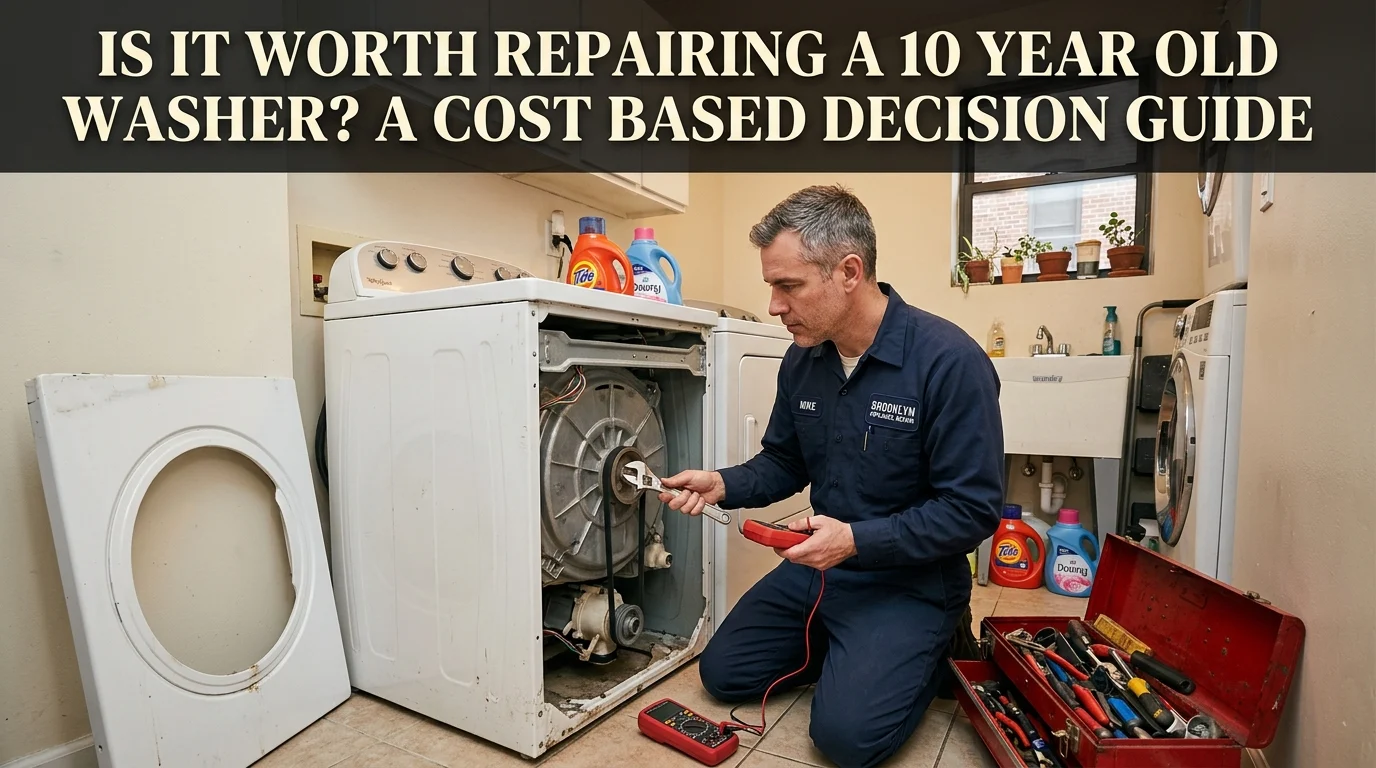
Yes, repairing a 10 year old washer is worth it when the failed part is cheap, and it stops being worth it the moment a major component goes. That single distinction settles most cases. Your machine has reached its average lifespan, so the question of whether it is worth repairing a 10 year old washer now depends far more on which part broke than on the age printed on the serial tag.
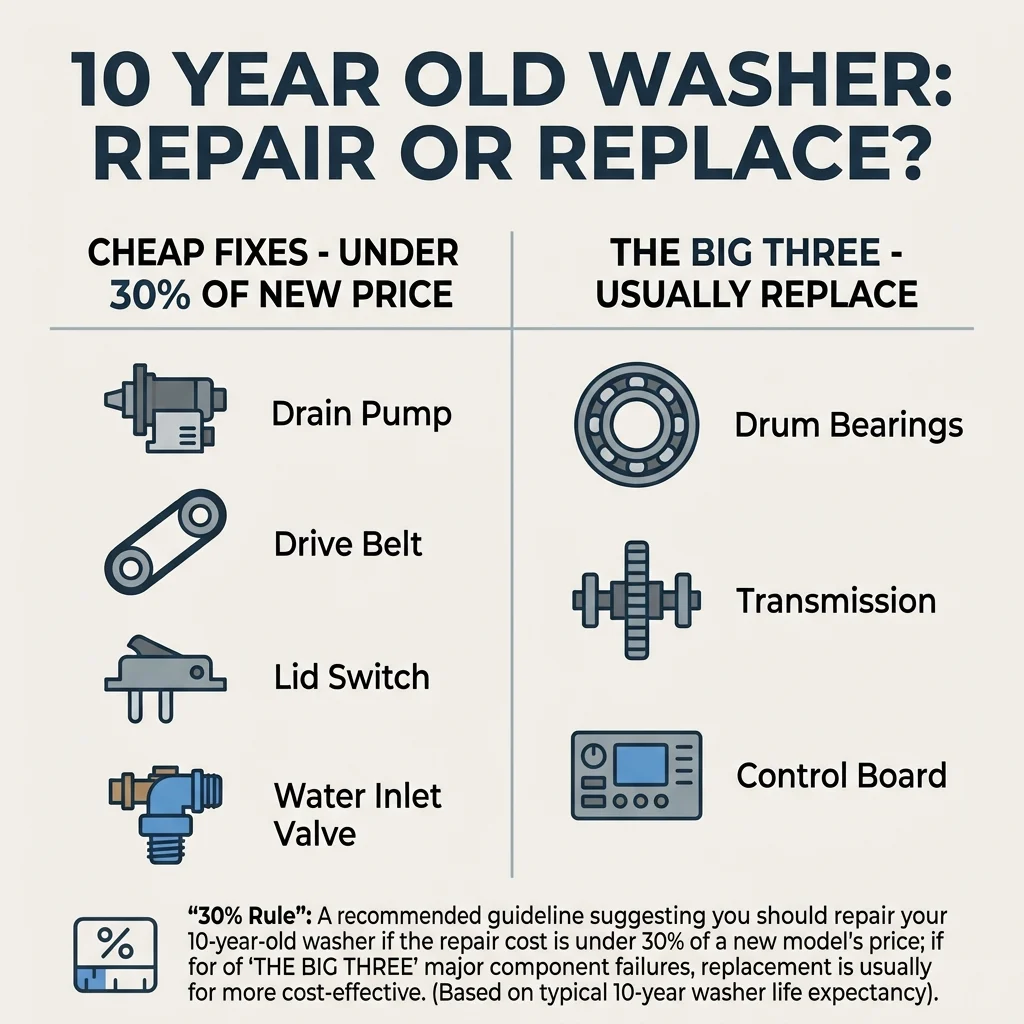
Repairing a 10 year old washer makes sense when the quote stays under 30% of a new machine. Drain pumps, drive belts, lid switches, and water inlet valves clear that bar easily. Drum bearings, transmissions, and control boards rarely do. Price the failure first, then decide.
Is It Worth Repairing a 10 Year Old Washer?
Most people know the 50% rule. If a repair costs more than half the price of a comparable new machine, you replace it. That rule works well for a five year old washer.
At ten years, tighten it. Use 30% instead.
The reason is simple math. A repair on a young machine buys you eight or nine more years of use. The same repair on a ten year old machine might buy you three. You are paying similar money for a much smaller return, so the threshold has to drop.
Here is the version you can hold in your head. Cheap part, fix it. One of the big three, which means bearings, transmission, or control board, start shopping.
Why 10 Years Is the Tipping Point, Not a Death Sentence
Ten years is an average, and averages hide a lot. Plenty of washers run past fifteen years with basic care. Some quit at seven.
Your machine sits somewhere on that curve based on three things: how many loads it ran each week, how well it was maintained, and how it was built. A Speed Queen or a Miele at ten years old has plenty of road left. A budget model that washed ten loads a week for a decade is closer to the end.
So treat ten years as the moment your decision gets stricter, not the moment your washer becomes worthless.
Your 10 Year Old Washer Is Not the Same as Everyone Else’s
Two machines can share a birthday and sit in completely different places on the curve. Design drives that difference.
Top Load Agitator at 10 Years
These are the simplest washers still sold. Fewer sensors, fewer seals, and a drivetrain that costs little to service. Twelve to fourteen years is common. At ten, a top load agitator machine still has real life ahead, which pushes the decision toward repair.
HE Top Load at 10 Years
Impeller based high efficiency top loaders land around ten to twelve years. Yours is right at the average. Small repairs still pay off. Anything costly deserves a hard look.
Front Load at 10 Years
Front loaders clean beautifully and spin more water out, but the drum hangs horizontally and the bearings carry that weight through every cycle. Eight to eleven years is typical. A ten year old front loader is already past average, so the bar for approving a repair sits highest here.
Repair Costs by Failure Type at Year 10
Price the problem, not the machine. A lid switch and a bearing job live in different financial universes.
Consumer Reports member survey data puts the median washer repair paid by owners at $155, with front loaders running higher than top loaders. That number matters, because it tells you the typical repair is small. You can read their survey findings directly.
The Cheap Failures That Are Almost Always Worth Fixing
Good news arrives here. The failures that happen most often are also the cheapest to fix.
Belts stretch and slip. Drain pumps swallow coins, hair ties, and the occasional sock, then quit draining halfway through a cycle. Lid switches wear out after thousands of cycles. Water inlet valves clog with mineral deposits.
Every one of these sits under the 30% line on a typical machine. Approve them and enjoy the extra years.
The Big Three That Usually End It
Bearings, transmissions, and control boards behave differently. Each one requires either a costly part or a full teardown, and often both.
A front load bearing job means pulling the drum, splitting the outer tub, and pressing new bearings in. That is hours of labor before parts. Rich Handel, the laundry expert at Consumer Reports, has described the front load bearing replacement as a job where you essentially take the whole machine apart to reach the part.
At ten years, any of the big three points toward a new machine.
The Cost Per Remaining Year Test
Percentage rules are blunt. They compare the repair to a purchase price and ignore what you actually buy with the money, which is time.
Try this instead. Divide the repair quote by the years you realistically expect afterward. Then divide the price of a new washer by eleven years. Compare the two figures.
Example one. A $200 drain pump on a ten year old top load agitator machine. That design often runs to thirteen or fourteen years, so call it three more years. Your cost is roughly $67 a year. A $700 new machine over eleven years costs $64 a year. Nearly identical, and the repair keeps $500 in your pocket today. Approve it.
Example two. A $480 bearing job on a ten year old front loader. Front loaders average eleven years, so you might gain two. That works out to $240 a year, well above the cost of simply owning a new one. Put the money toward a replacement.
This test also protects you in the other direction. A $150 fix that buys three years is excellent value, even on an older washer.
Before You Pay for a Service Call: Two Things to Check
Ten minutes of homework can save you a wasted appointment fee.
Check Parts Availability First
Find the model and serial number. On most top loaders the sticker sits under the lid or along the rim. On front loaders, check inside the door opening or behind the lower access panel.
Search that model number on the manufacturer’s parts site and on the major appliance parts retailers. You are looking for one thing: does the part you suspect still exist in stock?
For a ten year old model, common parts like pumps and belts are usually plentiful. Control boards and assemblies made for one specific model are the ones that disappear. When a board shows as discontinued everywhere, your decision is already made, and you saved yourself a service call.
Understand the Diagnostic Fee Before the Technician Arrives
Most companies charge for the visit and diagnosis. Ask three questions when you book:
- What is the diagnostic fee?
- Is it credited toward the repair if I approve the work?
- Will I get the quote in writing before anything is opened up?
Now the important part. Once you have paid that fee, you may feel pressure to approve whatever number comes back. Resist that feeling. The fee is spent either way, and it plays no role in whether the repair itself is a good buy.
Say this if the quote is high: “Thank you for the diagnosis. I want to compare this against replacement cost before I approve anything.” A professional technician will hand you the written quote and leave it with you. Many will tell you outright when a repair no longer makes sense.
Why One Failure at Year 10 Often Predicts the Next
Here is something the first quote rarely mentions. Every part inside your washer has run the same number of cycles.
The pump that just failed spun beside bearings, seals, hoses, and a motor that all accumulated identical wear. Fixing one part restores one part. The rest of the machine stays exactly as tired as it was yesterday.
Water exposure compounds this. Over a decade, moisture works on the cabinet, the frame, and the fasteners throughout. Corrosion spreads across the whole machine rather than one component.
That is why the second repair often follows the first within a year or two. And a third service call inside twenty four months tells you something clear: the machine is failing as a system, not as a part. At that point, further repairs stop paying for themselves.
The Risk Nobody Prices In: Water Damage
A ten year old washer carries a small financial risk that sits outside the repair quote entirely.
Three leak points age together. Rubber supply hoses grow brittle and can split under constant pressure. The door boot on a front loader hardens and tears at the fold. The outer tub can develop hairline cracks that weep slowly during spin.
A slow leak behind or beneath a washer stays hidden for weeks. By the time you notice, you may be looking at flooring or subfloor work that dwarfs any repair bill.
Three inexpensive moves protect you regardless of which way you decide:
- Swap rubber supply hoses for braided stainless steel versions.
- Put a drain pan under the machine, especially on an upper floor.
- Close the supply valves when you travel.
- Do these even if you replace the machine tomorrow.
Signs Your Washer Is Done Regardless of Repair Cost
Some conditions settle the question by themselves.
- Rust on the frame or a cracked outer tub: Corrosion spreads, and a cracked tub means water where it does not belong.
- Grinding or rumbling that worsens each cycle: That sound is bearings, and bearings on a ten year old machine mean replacement.
- Repeat breakdowns: Three calls in two years is a system in decline.
- Discontinued parts: No part, no repair.
- Several failures at once.:A motor plus a board plus a pump always costs more than a new washer.
- Safety issues: Sparking, a burning smell, or violent walking across the floor means stop using the machine and replace it.
If You Own Rentals: The Math Changes
Landlords should replace earlier than homeowners at the same repair price, and the reason has little to do with the appliance.
Every breakdown generates a tenant call, a scheduling window, and a follow up. Your time carries real value. A machine that needs two visits a year costs you far more than the invoices show.
Downtime matters too. A tenant waiting five days for a part is a tenant with a legitimate complaint.
For rental units, simple beats fancy. A basic top load agitator machine has fewer electronics to fail, costs less to service, and parts stay available longer. Skip the touchscreen and the smart features.
On the accounting side, appliance purchases for rental property are generally treated as depreciable assets rather than immediate expenses. Rules vary by situation and by country, so confirm the treatment with your tax professional before you file.
What to Do With the Old Washer If You Replace It
Your old machine still holds value. Choose one of these paths.
- Sell it working: A washer with a known, disclosed fault still sells to buyers who repair machines. Describe the exact symptom honestly and price it accordingly.
- Scrap it: Washers contain a solid amount of steel plus a copper wound motor. Scrap yards pay by weight, and some will collect from your driveway.
- Use retailer haul away: Most retailers remove the old unit when they deliver the new one. Ask one question before you agree: is the machine recycled or landfilled?
- Recycle it properly: Appliance recycling recovers metals and handles the components that should never reach a landfill. The EPA’s Responsible Appliance Disposal program explains how certified recycling works and is worth a quick look at epa.gov. Many utility companies also run bounty programs that pay you to retire an old appliance.
If You Decide to Replace: What Actually Matters
Shop on total landed cost, not the sticker price. Add delivery, hookup, and haul away, which together often add $100 to $300.
Put reliability ahead of feature count. Whirlpool, Maytag, LG, Samsung, GE, Bosch, Miele, Frigidaire, Electrolux, and Speed Queen all build capable machines, and the models that last tend to be the ones with fewer things to break.
Treat efficiency as a tiebreaker rather than a reason to buy. Modern washers use dramatically less energy and water than machines from decades past, and the U.S. Department of Energy covers those savings in detail. Those savings are real, but they arrive slowly compared with the purchase price. Let repair math lead, and let efficiency break a tie. You can compare certified models through ENERGY STAR.
Finally, read the warranty. A manufacturer offering long coverage on the motor and drum is telling you something about its own confidence.
Frequently Asked Questions
Is it worth repairing a 10 year old washing machine?
Sometimes. At ten years, the machine has reached its average lifespan, so the repair price decides it. A belt, lid switch, or drain pump under $250 buys several more good years. Bearings, a transmission, or a control board at this age usually cost more than the washer is worth.
Is it worth repairing a 15 year old washing machine?
Rarely. A fifteen year old washer is well past average, and most parts are tired even when only one has failed. A trivial fix like a lid switch still makes sense. Anything above roughly $150 belongs toward a replacement, unless you own a commercial grade machine built to run for decades.
Is it worth repairing a washing machine if the bearings have gone?
Only on a newer front loader, and even then it is close. Bearing jobs run $350 to $550 because the drum comes out and the outer tub gets split open. Under five years, the math can work. Past eight years, worn bearings are the clearest sign the washer is finished.
When is it not worth repairing a washing machine?
Skip the repair when the quote tops half the price of a comparable new machine and the washer sits past the midpoint of its life. Rust on the tub, repeat breakdowns within two years, and discontinued parts all point the same direction. Put the money toward a replacement instead.
How much does it cost to fix a washing machine?
Most washer repairs land between $150 and $350. Simple fixes like a lid switch or a belt cost less. Motors, bearings, control boards, and transmissions run $200 to $550. Expect a separate diagnostic fee for the visit, and ask whether that fee gets credited toward the repair.
What is the most expensive washing machine repair?
Drum bearings and the transmission top the list at $300 to $550 each, with control boards close behind. All three require either a major teardown or a costly part, which is exactly why they trigger the replace decision on older machines. Belts, switches, and valves fail more often and cost a fraction as much.
How long do washing machines last?
About ten years on average. Top load agitator machines often reach twelve to fourteen years because the design stays simple. Front loaders average closer to eight to eleven, since the bearings carry the drum weight through every spin. Care counts too, and a level, well maintained washer outlasts a neglected one.
Should I replace my washer and dryer at the same time?
No, not unless both have failed. Dryers are simpler machines and routinely outlast washers, so a dying washer says nothing about the dryer beside it. Paying several hundred dollars extra for a matching set is money spent on symmetry. Buy the washer and keep the dryer.
Which brand washing machine lasts longer?
Speed Queen and Miele have the strongest reputations for longevity, and both can pass twenty years with care. Bosch, Whirlpool, LG, and Maytag also build durable machines. Usage habits and maintenance still matter more than the badge, since a neglected premium washer loses to a well treated budget one.
What is the common failure of a washing machine?
Drain pumps lead the list, usually clogged by coins, hair ties, or a stray sock. Worn drive belts, faulty lid switches, damaged door seals, and clogged water inlet valves follow close behind. Happily, these are also among the cheapest repairs, which is why most broken washers are worth fixing.
What are signs of a bad washing machine?
Watch for grinding or banging during spin, clothes that stay soaked after the cycle, water pooling under the machine, and error codes that keep returning. Excessive walking across the floor and a persistent musty odor also signal trouble. Several of these together suggest the machine is declining as a whole.
Why do old washers last longer?
Older machines used mechanical timers and fewer electronics, so there was simply less to fail. They also used heavier metal parts. The trade was much higher water and energy use per load, along with fewer cycles and gentler fabric care. Modern machines wash better and cost less to run.
Is it worth repairing a 7 year old washing machine?
Usually yes. At seven years a washing machine still has three to five good years left, so most repairs pay off. A pump, belt, valve, or lid switch is an easy call. Only a bearing or transmission failure needs a second look at this age. If you are wondering how much does it cost to repair a washer, most jobs land between $150 and $350.
Is it worth repairing a 5 year old washing machine?
Almost always. A five year old washing machine is barely past the halfway mark of its life, and nearly every repair beats replacement at this point. Even a pricier part like a control board is worth fixing because you still have years of use ahead.
Repair or replace a 12 year old washer?
At twelve years the washer is past average, so lean toward replacement once the quote climbs. A cheap fix under $150 can still buy time, but for anything bigger the money is better spent on a new machine. The same logic answers whether it is worth fixing a 14 year old washer: only the smallest repairs make sense that late.
Is it worth repairing a 10 year old LG washing machine?
Whether a 10 year old washer is worth fixing comes down to the failed part. LG front loaders are well built, so a control board or direct drive motor repair on a ten year old LG washing machine can be worth it when parts are in stock. Bearing failure is the usual dealbreaker, since that job runs $350 to $550.
The Bottom Line
Price the failure, not the machine. That one habit answers this question faster than any rule of thumb.
At ten years, a $200 pump on a healthy top loader is money well spent. A $480 bearing job on a front loader that already sounds like a jet engine is money handed away. Check parts availability, ask for the quote in writing, run the cost per remaining year test, and decide with numbers rather than guesswork. Need a second opinion on your own machine in Bensonhurst or anywhere in Brooklyn? See our washer repair page or book a same-day diagnostic.