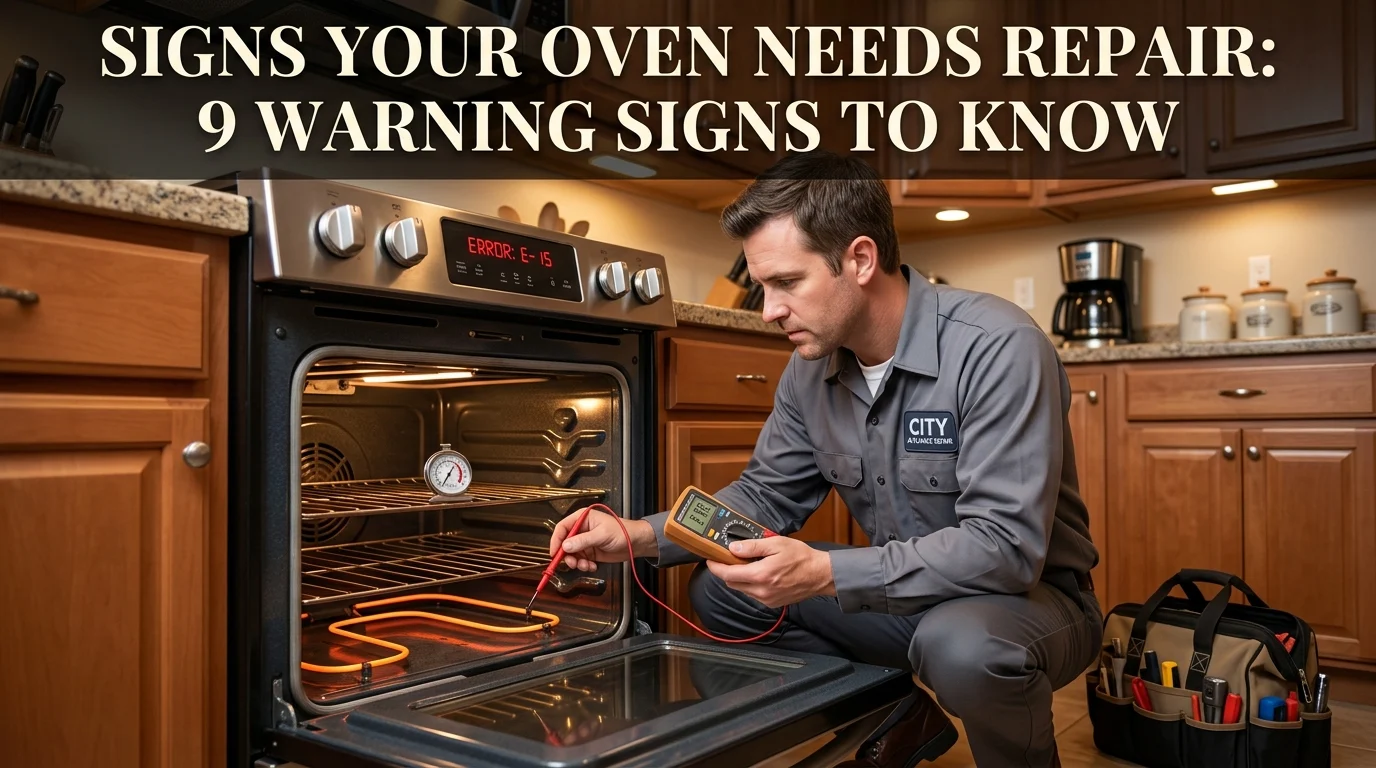
If your oven is cooking food unevenly, taking too long to heat, making strange noises, or showing error codes, these are the clearest signs your oven needs repair. Catching these signs early can save you money and keep your kitchen safe.
Every kitchen depends on a working oven. When it starts acting strange, meals suffer and stress builds. Many homeowners wait too long before calling a technician, and small issues turn into bigger, costlier ones. This guide walks through the real warning signs of oven trouble, explains what causes each one, and helps you decide whether repair or replacement makes more sense for your home. If you already suspect a specific fault, our oven and stove repair page covers the fixes our technicians handle most often.
Signs your oven needs repair include uneven cooking, temperature swings, slow ignition, strange smells or gas odor, a door that won’t seal, loud noises, unresponsive controls, and rising energy bills. Any of these point to a part that is wearing out and needs a technician’s attention soon.
Oven Repair Signs at a Glance
Uneven or burnt cooking: often a worn heating element or fan. Call a pro if the element looks damaged.
Oven will not reach temperature: usually a faulty thermostat or sensor. Call a pro if it is off by more than 25 degrees.
Slow or weak igniter: a worn glow bar. This always needs licensed service.
Gas smell: a leak, a bad valve, or a faulty igniter. Call a pro immediately.
The door will not seal: a cracked gasket or worn hinges. Call a pro if the gasket is torn.
Strange noises: a loose fan blade or a failing motor. Call a pro if the noise continues.
Control panel issues: a damaged board or wiring. Call a pro if codes keep repeating.
Strange odors or smoke: food debris, grease, or wiring damage. Call a pro if the smell continues after cleaning.
Rising energy bills: heat loss from a bad seal or worn insulation. Call a pro if the seal looks fine but bills keep climbing.
Common Signs Your Oven Needs Repair
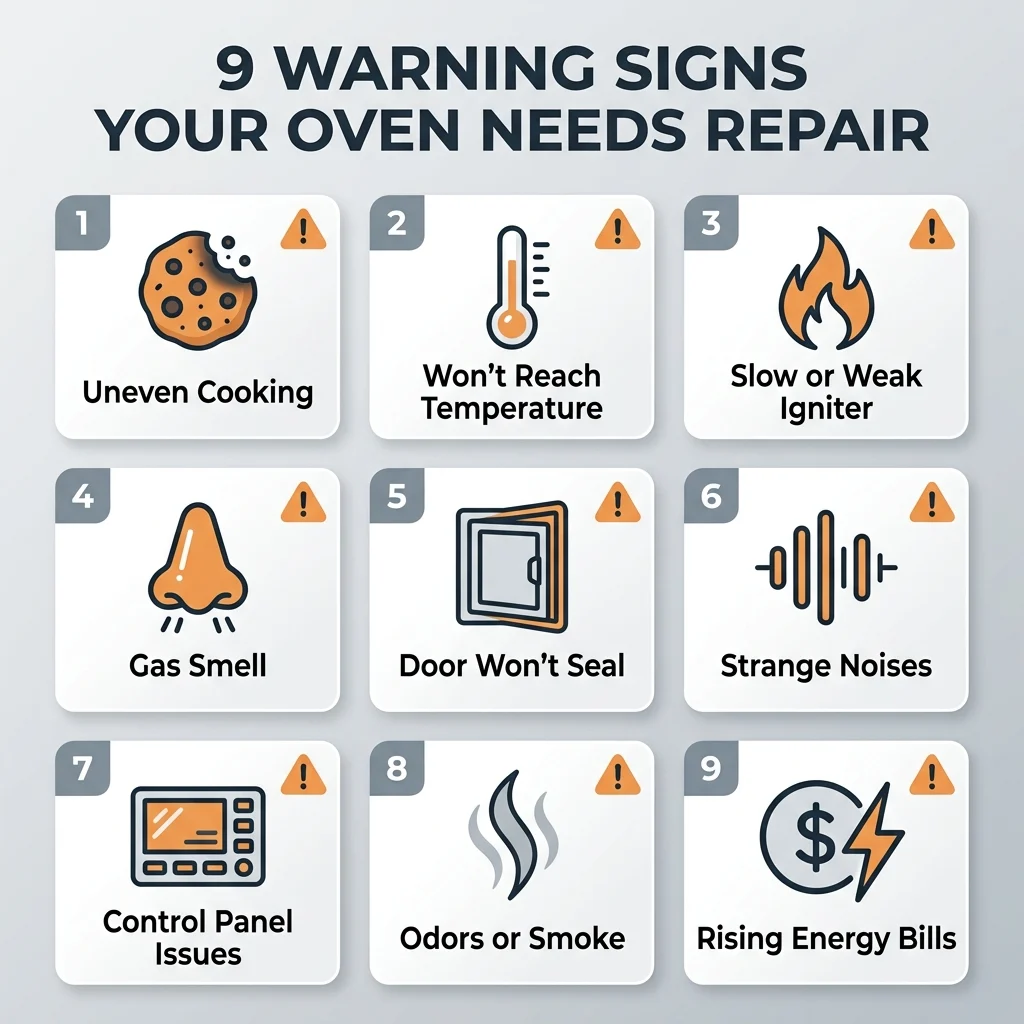
1. Uneven or Inconsistent Cooking
Cookies burnt on one side and pale on the other point to a heat distribution problem. A worn heating element, a failing convection fan, or blocked vents can all cause this. Food safety matters too, since the CDC recommends cooking food to a safe temperature every time. An oven that heats unevenly makes that harder to guarantee. Learn more about safe cooking temperatures from the CDC.
2. Oven Won’t Reach or Hold the Right Temperature
Recipes rely on accurate heat. If your dish always comes out underdone or overdone at the set temperature, a drifted thermostat or a worn sensor is often the cause. Place an oven thermometer on the middle rack and compare it to your set temperature after a full preheat. A gap of more than 25 degrees usually means it is time for a service call.
3. Slow, Weak, or Failed Igniter (Gas Ovens)
Gas ovens rely on a glow bar igniter to heat up and open the gas valve. A healthy igniter glows bright and lights the burner within about 45 seconds. A weak one takes far longer, or glows dim orange instead of white. This delay lets unburned gas build up before ignition, which raises fire risk. This sign should never be ignored.
4. Gas Smell or Pilot Light Won’t Stay Lit (Gas Ovens)
Any gas odor from your oven is an urgent safety signal. Turn off the gas supply, open windows, and avoid using any flame or electrical switch nearby. Do not try to diagnose this yourself. Call a licensed technician or your gas utility right away. The Department of Energy notes that a properly working gas oven should burn with a steady blue flame, not yellow tips, since yellow flames signal inefficient or unsafe combustion. See the Department of Energy’s guidance on gas kitchen appliances.
5. Door Won’t Close, Seal, or Latch Properly
The gasket around your oven door keeps heat inside where it belongs. Over time it can harden, crack, or pull away from the door. Loose hinges create the same problem. Heat escapes, cook times stretch, and your kitchen gets warmer than it should. Check the gasket for cracks and confirm the door closes fully on its own from a slight angle.
6. Unusual Noises During Operation
Ovens run quietly during normal use. Buzzing, rattling, or clicking sounds usually point to a loose fan blade, a worn motor bearing, or a failing electrical connection. A single odd sound during preheat is worth a listen next cycle, but a noise that repeats or grows louder is a clear signal to schedule service.
7. Control Panel, Display, or Error Code Problems
Modern ovens rely on a control board to manage temperature, timers, and modes. If buttons stop responding, the display flickers, or the same error code returns after a breaker reset, the board or its wiring likely needs attention. Photograph any code before it clears so a technician can identify the fault faster.
8. Strange Odors or Smoke (Not Related to Gas)
A faint smell during an oven’s first few uses is normal, since manufacturing oils burn off. A persistent burning plastic smell, an electrical odor, or visible smoke is not normal. Clean the oven thoroughly first to rule out food debris or grease. If the smell continues after cleaning, damaged wiring or an overheating part could be the source, and that calls for a professional look.
9. Rising Energy Bills Without Explanation
If your utility bill keeps climbing while your cooking habits stay the same, your oven may be working harder than it should. A cracked door seal, failing insulation, or a struggling heating element all force the appliance to draw more power. Check the seal first, since it is the easiest and cheapest fix among the possible causes.
Gas Oven vs. Electric Oven: Do the Warning Signs Differ?
Most warning signs apply to both fuel types, but a few symptoms point straight to one or the other.
Gas Specific Warning Signs
Gas ovens show trouble through the burner and ignition system first. Watch for a slow igniter, a pilot light that keeps going out, uneven flame color, or any gas smell. These symptoms trace back to the gas valve, igniter, or burner tube, and all of them call for a licensed technician rather than a DIY fix.
Electric Specific Warning Signs
Electric ovens show trouble through their heating elements and electronics first. Watch for an element that glows unevenly or not at all, a tripped breaker, or a control board that stops responding. Electrical issues carry shock risk, so leave wiring work to a trained professional.
Is It Safe to Keep Using Your Oven While You Wait for Repair?
It depends on the sign. Minor issues, like a slightly noisy fan or a small temperature drift, usually allow continued use while you schedule service, as long as you monitor cooking closely and confirm doneness with a food thermometer. Serious signs change that answer completely. Stop using the oven right away if you smell gas, see smoke, notice an electrical odor, or find exposed wiring. Waiting on those symptoms adds real risk to your home.
Repair or Replace? How to Decide
Average Oven Repair Costs by Issue
Repair costs vary by the part involved. A heating element or igniter replacement often falls in the lower range, while a control board or gas valve replacement runs higher due to part cost and labor time. Getting an actual quote from a technician gives you the clearest picture for your specific oven.
The 50 Percent Rule
A simple rule many homeowners use is this: if the repair cost is under half the price of a new equivalent oven, repair usually makes sense. Most common oven faults, like a worn element or a failed igniter, fall well within that range.
When Replacement Makes More Sense
Replacement becomes the smarter choice when your oven is well past 10 to 15 years old, when one repair keeps leading to another, or when the interior shows heavy rust or a warped frame. At that point, a new oven often costs less over time than continued repairs on an aging unit. A technician can give you an honest read on which side of that line your oven falls on. You can reach our team for a written quote before any work begins.
Simple DIY Checks You Can Safely Do Before Calling a Pro
A few checks are safe for any homeowner to try, since none involve opening electrical or gas components.
- Run an empty preheat cycle: Set the oven to 350 degrees and watch the elements. They should glow evenly across the surface.
- Test with an oven thermometer: Place it on the middle rack and compare the reading to your set temperature after a full preheat.
- Inspect the door gasket: Look for cracks, hardening, or gaps around the seal.
- Listen during operation: Note any new buzzing, clicking, or rattling and when it starts.
- Check for visible damage: Look at heating elements for cracks, blisters, or dark spots.
Skip any check involving wiring, the control board, or gas connections. Those steps belong to a licensed technician.
Frequently Asked Questions About Oven Repair
Is it worth repairing an oven or should I replace it?
Usually yes, especially if the oven is under 10 to 15 years old and the fault involves a single part like a thermostat or heating element. Replacement makes more sense once repairs keep recurring.
How much does it cost to repair an oven?
Costs vary by part. Simple fixes like a heating element or igniter tend to cost less, while a control board or gas valve replacement costs more due to labor and part price.
How long should an oven last?
Most ovens last between 13 and 20 years with regular care, though parts like the igniter, sensor, or gasket may need attention every 5 to 10 years as routine wear.
Why is my oven not cooking evenly?
Uneven cooking usually comes from a worn heating element, a failing convection fan, or thermostat drift. Rack placement and airflow around the food can play a role too.
What should I do if I smell gas from my oven?
Turn off the gas supply at the shutoff valve, open windows, avoid any flame or electrical switch, and contact a licensed technician or your gas utility right away.
Can a faulty oven increase my energy bills?
Yes. A failing seal, worn insulation, or a struggling heating element forces the oven to use more power to reach the same temperature, which raises utility costs over time.
Should I repair or replace my oven if it’s over 10 years old?
It depends on the fault and the repair cost. If the repair is under half the price of a new equivalent oven and the unit is otherwise in good shape, repair often remains the better value.
Final Thoughts
Most oven problems start small, whether it is a slightly slow igniter or a door that does not quite seal. Watching for these signs your oven needs repair, and acting on them early, keeps your kitchen running safely and your meals coming out the way they should. When a symptom involves gas, wiring, or a part you cannot safely inspect yourself, schedule a professional diagnosis rather than guessing at the cause. Visit our oven and stove repair page or contact us to book a visit.