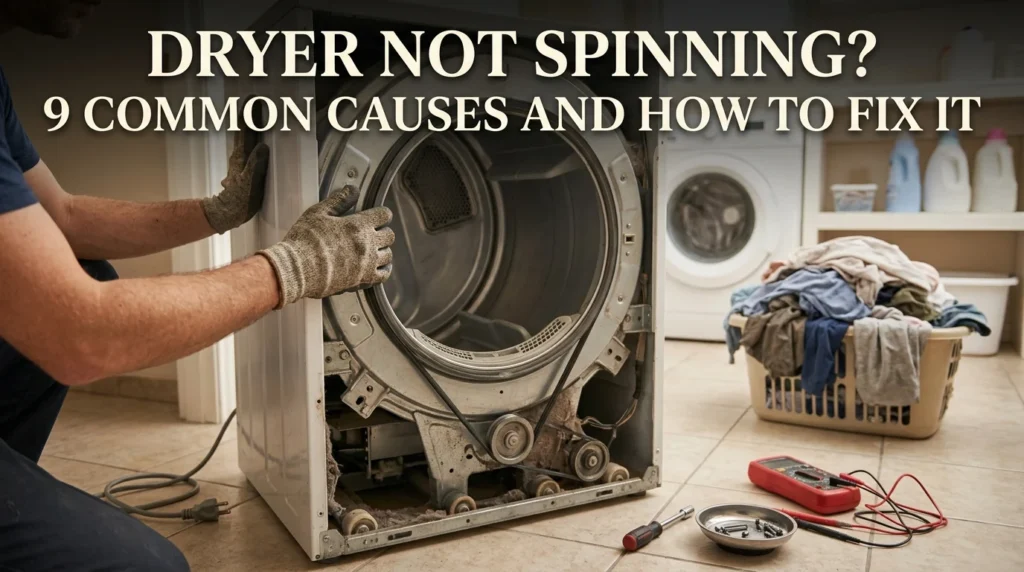
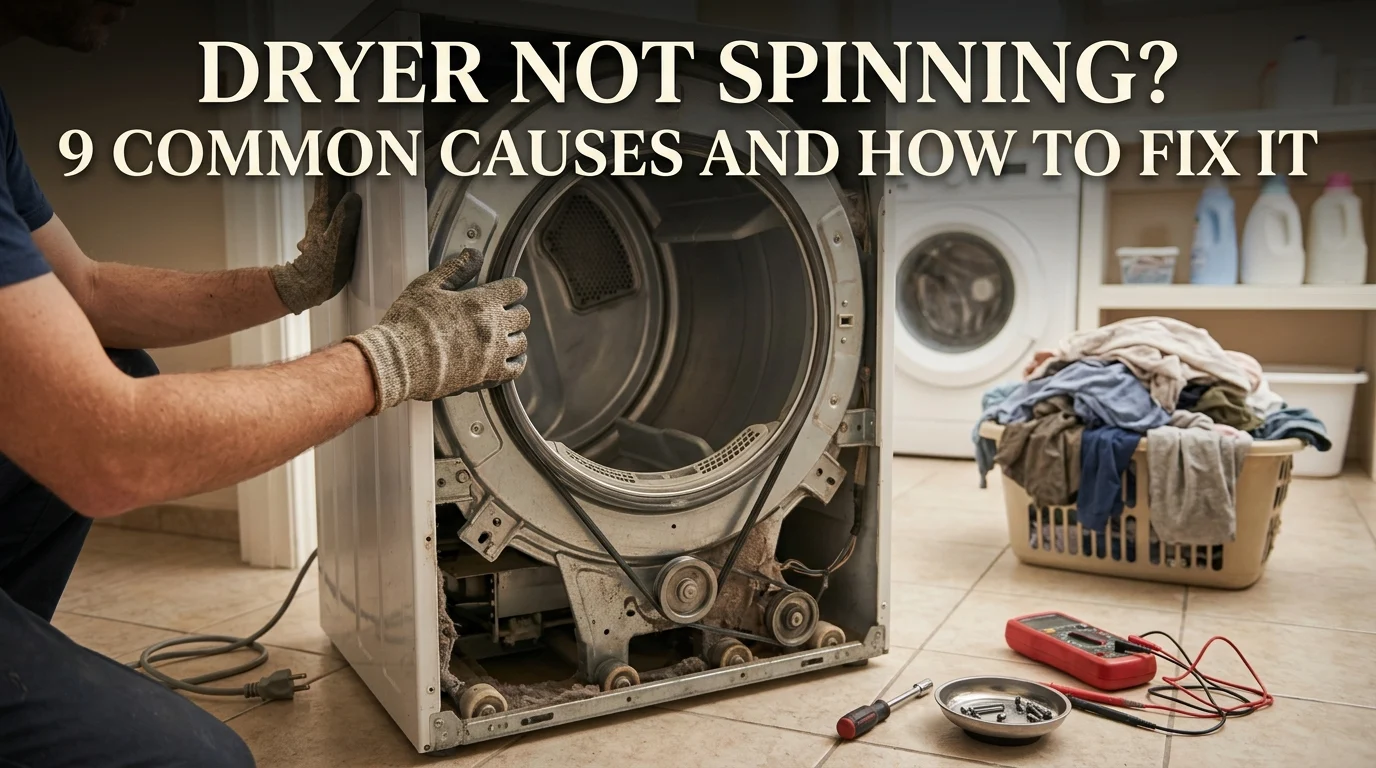
A dryer not spinning is often caused by a broken drive belt, faulty motor, worn drum rollers, or an electrical problem. Checking the sound, heat, and drum movement can help you find the cause.
Finding your dryer not spinning can be frustrating, especially when you have wet clothes waiting. Some causes are simple, like a door that has not closed properly. Others involve a worn belt, damaged motor, or faulty electrical part.
Your dryer may make a humming sound, produce heat without tumbling, or stay completely silent. Each symptom helps narrow down the problem.
This guide explains nine common causes, safe checks you can try, and when professional repair is the better choice.
A dryer may stop spinning because of a broken drive belt, faulty motor, worn drum rollers, damaged pulley, or defective door switch. Electrical faults can also prevent the drum from moving. Check the power, door latch, and settings first. If the motor runs but the drum stays still, the drive system may need repair.
Why Is My Dryer Not Spinning?
A clothes dryer uses a motor to turn its drum. In many dryers, a drive belt connects the motor to the drum. An idler pulley keeps the belt tight, while drum rollers or bearings help the drum move smoothly.
When one of these parts wears out, the drum may stop turning.
Electrical parts also play an important role. The door switch, thermal fuse, start switch, and electronic control board help manage dryer operation.
Before checking internal parts, pay attention to what happens when you press Start.
| Dryer symptom | Possible cause | What to check |
| Motor runs, but drum stays still | Broken belt or damaged pulley | Drive system |
| Dryer hums without spinning | Motor or stuck drum | Motor and drum movement |
| Dryer heats but does not spin | Mechanical or control fault | Belt and motor |
| Dryer makes no sound | Power or switch problem | Breaker, door, and controls |
| Belt is intact, but drum stays still | Worn rollers or motor problem | Drum support parts |
| Dryer has no heat or movement | Electrical supply or control fault | Power and safety switches |
These symptoms provide useful clues. The exact cause depends on the dryer model.
9 Common Reasons Your Dryer Is Not Spinning
A dryer not spinning often points to a problem with the drive system or a part that controls the motor.
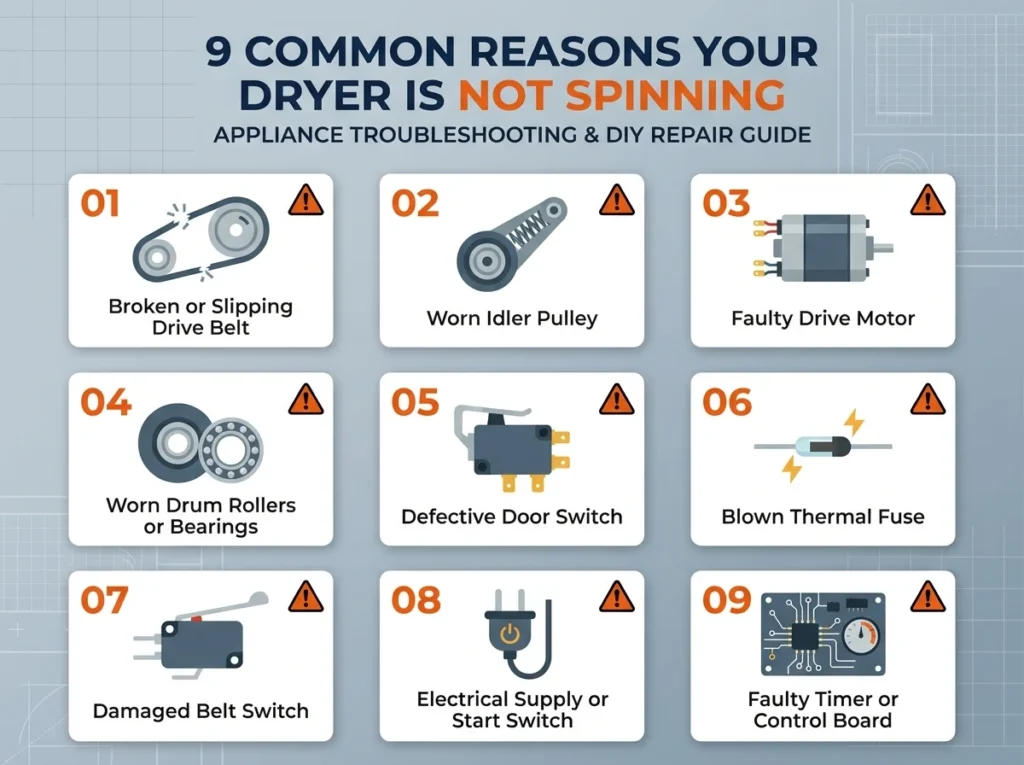
1. Broken or Slipping Drive Belt
The drive belt transfers movement from the motor to the dryer drum. It wraps around the drum and connects to the motor pulley.
Over time, the belt can stretch, wear out, or break.
Common signs include:
- The motor runs, but the drum does not turn.
- The drum feels unusually easy to rotate by hand.
- The dryer suddenly stops tumbling.
How to fix it: Disconnect the dryer from power before any inspection. A damaged belt needs replacement with the correct part for the model.
The idler pulley should also be checked because pulley damage can cause the belt to slip or wear.
If the drum stays still after basic checks, homeowners can explore dryer repair services in Brooklyn for help with the belt, motor, and drum components.
2. Worn or Damaged Idler Pulley
The idler pulley maintains tension on the drive belt.
When the pulley wears out, the belt may slip or move out of position. This can stop the drum from turning.
A damaged pulley may also cause squeaking or chirping sounds.
How to fix it: A technician can inspect the pulley, belt tension, and motor pulley. Replacing the damaged component can help restore normal drum movement.
3. Faulty Dryer Drive Motor
The drive motor powers the drum. On many dryers, it also turns the blower wheel.
A motor problem may prevent the drum from starting or cause the dryer to stop during a cycle.
Common signs include humming, sudden stopping, or unusual motor sounds.
However, a humming motor may also be caused by a stuck drum or blocked blower wheel.
How to fix it: Turn off the dryer and avoid repeated start attempts. A technician can inspect the motor and mechanical parts to find the cause.
4. Worn Drum Rollers or Bearings
Drum rollers and bearings support the dryer drum as it rotates.
When these parts wear out, they create friction and make the drum harder to turn.
You may hear grinding, squealing, or rumbling before the drum stops.
How to fix it: Unplug the dryer and gently rotate the empty drum by hand. If it feels stuck or rough, the rollers or bearings may need inspection and replacement.
5. Defective Door Switch
The door switch helps prevent the dryer from running when the door is open.
If the switch fails, the motor may not start.
Sometimes the display lights up, but the drum remains still.
How to fix it: Check that the door closes fully and nothing blocks the latch. If the dryer still will not start, the switch may need testing.
Never bypass the door switch.
6. Blown Thermal Fuse
A thermal fuse protects many dryers from excess heat.
On some models, a blown thermal fuse interrupts power to the motor.
Restricted airflow, lint buildup, or other faults may cause overheating.
How to fix it: A technician can test the fuse and inspect the exhaust vent, blower wheel, and airflow system.
The cause of overheating must be addressed before normal use resumes.
7. Damaged Belt Switch
Some dryer models use a belt switch that stops the motor when the drive belt breaks.
If the switch fails, the dryer may not start even when the belt is intact.
How to fix it: Check the appliance manual to confirm whether your dryer has a belt switch.
A technician can inspect the belt mechanism and test the switch.
8. Electrical Supply or Start Switch Problems
A dryer needs the correct electrical supply to operate.
A tripped circuit breaker, faulty outlet, damaged power cord, or defective start switch can prevent the motor from running.
Many full size electric dryers in the United States require a 240 volt supply. Gas dryers often use a different electrical setup.
How to fix it: Check the circuit breaker and visible power connection.
If the breaker keeps tripping or the cord shows damage, stop using the dryer and contact a qualified professional.
9. Faulty Timer or Electronic Control Board
The timer or electronic control board manages dryer cycles and sends signals to the motor.
When these parts fail, the dryer may not respond to the Start button.
Working display lights do not always mean the motor circuit is receiving the correct power.
How to fix it: A technician should test the power supply, switches, and motor circuit before replacing the timer or control board.
What Different Dryer Symptoms Mean
The sound and behavior of your dryer can help you identify which parts may need attention.
Dryer Is Not Spinning but Making Noise
If your dryer is not spinning but making noise, the type of sound matters.
Squeaking may come from worn rollers or an idler pulley. Grinding can point to damaged drum bearings.
A rattling sound may indicate a loose component or an object near the drum.
Stop the dryer if you hear unusual mechanical sounds. Continued operation can cause more damage.
Dryer Not Spinning but Motor Running
A dryer not spinning but motor running often means the motor is operating, but its movement is not reaching the drum.
A broken belt, slipping belt, or damaged pulley may be responsible.
The drive system should be inspected before replacing the motor.
Dryer Not Spinning Only Humming
A dryer not spinning only humming may have a motor that receives power but cannot begin turning.
A stuck drum, jammed blower wheel, or faulty motor can cause this symptom.
Turn off the appliance and avoid repeated start attempts. A technician can inspect the motor and nearby parts.
Dryer Not Spinning but Heating
A dryer not spinning but heating needs prompt attention.
Some dryer designs may produce heat even when the drum is stationary.
Clothes cannot tumble properly, and heat may build up around the load.
Turn off the dryer and let it cool. Avoid using it again until the cause has been repaired.
Dryer Not Spinning With No Noise
A dryer not spinning no noise problem may indicate that the motor is not starting.
Check the circuit breaker, door latch, power connection, and control settings.
If the display works but the dryer remains silent, the door switch, start switch, or another control part may need testing.
Dryer Not Spinning or Heating
When a dryer is not spinning or heating, start by checking the power supply.
Look at the display and see whether the dryer responds to the Start button.
A faulty door switch, thermal fuse, or control component may prevent normal operation.
Electrical testing may be needed if basic checks do not solve the problem.
Dryer Not Spinning but Belt Not Broken?
A dryer not spinning belt not broken problem means the cause may be somewhere else in the drive system.
An intact belt can still slip if the idler pulley does not maintain proper tension.
Other possible causes include:
- A worn motor pulley
- Damaged drum rollers
- A seized drum bearing
- A faulty drive motor
- A belt that has moved out of position
With the power disconnected, gently try turning the empty drum by hand.
If it feels difficult to move, worn support parts may be creating too much friction.
A professional inspection can help identify the correct repair before parts are replaced.
How to Troubleshoot a Dryer That Won’t Spin Safely
A few simple checks can help you understand the problem before arranging a repair.
Step 1. Check the Power Supply and Circuit Breaker
Make sure the dryer is connected to the correct outlet.
Check whether the circuit breaker has tripped.
If the outlet, cord, or plug shows signs of damage, stop using the appliance.
Step 2. Check the Door and Control Settings
Open and close the door to confirm that it latches securely.
Look for clothes caught near the door.
Check whether Control Lock is enabled, if your model has that feature.
Select a normal drying cycle and follow the Start button instructions.
Step 3. Listen for Unusual Motor or Drum Sounds
If there are no signs of overheating or electrical trouble, try one brief start attempt.
Listen for humming, grinding, or squeaking.
Stop the dryer if the drum stays still or produces unusual sounds.
Step 4. Check Drum Resistance With the Power Disconnected
Unplug the dryer before touching the drum.
For a gas dryer, avoid moving the appliance or disturbing its gas connection.
Gently rotate the empty drum by hand.
A drum that feels stuck or rough may have worn support parts.
Never force the drum to move.
Step 5. Know When Internal Component Testing Is Needed
Internal dryer repairs may involve the motor, drive belt, switches, or control board.
A technician may use a multimeter to test electrical continuity and inspect damaged parts.
Do not open energized equipment or bypass safety devices.
Why Is My Whirlpool Dryer Not Spinning?
If your Whirlpool dryer is not spinning, begin with the door latch, power supply, and control settings.
Some models include a Control Lock feature that prevents the dryer from starting.
A broken belt, faulty motor, or worn drum part may also prevent rotation.
Try these checks:
- Make sure the door closes properly.
- Check whether Control Lock is enabled.
- Select the correct drying cycle.
- Follow the Start button instructions.
- Check the circuit breaker.
If the motor runs but the drum stays still, the drive system may need inspection.
Use the exact model number when checking parts or repair instructions.
When Should You Call a Dryer Repair Technician?
Some dryer problems can be solved by correcting a setting or restoring power.
Other faults require internal testing and replacement parts.
Consider professional help when:
- The motor hums but the drum does not turn.
- The dryer makes grinding or squealing sounds.
- The drum is difficult to rotate.
- The circuit breaker trips repeatedly.
- The dryer heats without tumbling.
- A motor, belt, switch, or control board needs replacement.
A trained technician can inspect the motor, belt, rollers, and electrical controls to identify the problem.
GS Appliance Repair provides gas and electric dryer repair in Brooklyn. You can also review its available appliance repair services if another household appliance needs attention.
Before approving a repair, ask about the diagnosis, replacement parts, and total cost.
Frequently Asked Questions
Can You Still Use a Dryer if It Doesn’t Spin?
No. A dryer needs drum movement to tumble clothes properly. Continued operation with a stationary drum can lead to poor drying and may create excess heat in some fault conditions. Turn it off until the problem is repaired.
Can I Fix My Dryer Myself?
You can check the power supply, door latch, circuit breaker, and control settings. These simple checks may solve an operating problem. Internal repairs involving motors, wiring, thermal fuses, or safety switches require proper training.
Why Is My Tumble Dryer Not Spinning?
A tumble dryer may stop spinning because of a broken belt, worn rollers, faulty motor, or electrical issue. Start with the power and door checks. Then use the sounds and drum movement to narrow down the possible cause.
Why Does My Dryer Motor Hum but Not Spin?
A humming motor may be receiving power without being able to turn. A stuck drum, blocked blower wheel, or motor fault may be responsible. Stop repeated start attempts and arrange an inspection.
Why Do My Dryer’s Lights Come On but the Drum Won’t Spin?
Working lights show that part of the dryer has electrical power. The motor circuit may still have a fault. A defective door switch, start switch, belt switch, motor, or control part may prevent the drum from moving.
Final Thoughts
A dryer not spinning can often be traced to a drive belt, motor, drum support part, or electrical control issue.
Start with safe checks, including the power supply, door latch, and settings. Pay attention to sounds and drum movement because they provide useful clues.
If the dryer continues to malfunction, professional diagnosis can help prevent unnecessary part replacement.
Brooklyn homeowners can schedule a dryer repair appointment with GS Appliance Repair and explain the symptoms before the visit.
Finding the cause early can help restore normal dryer operation and protect the appliance from further damage.