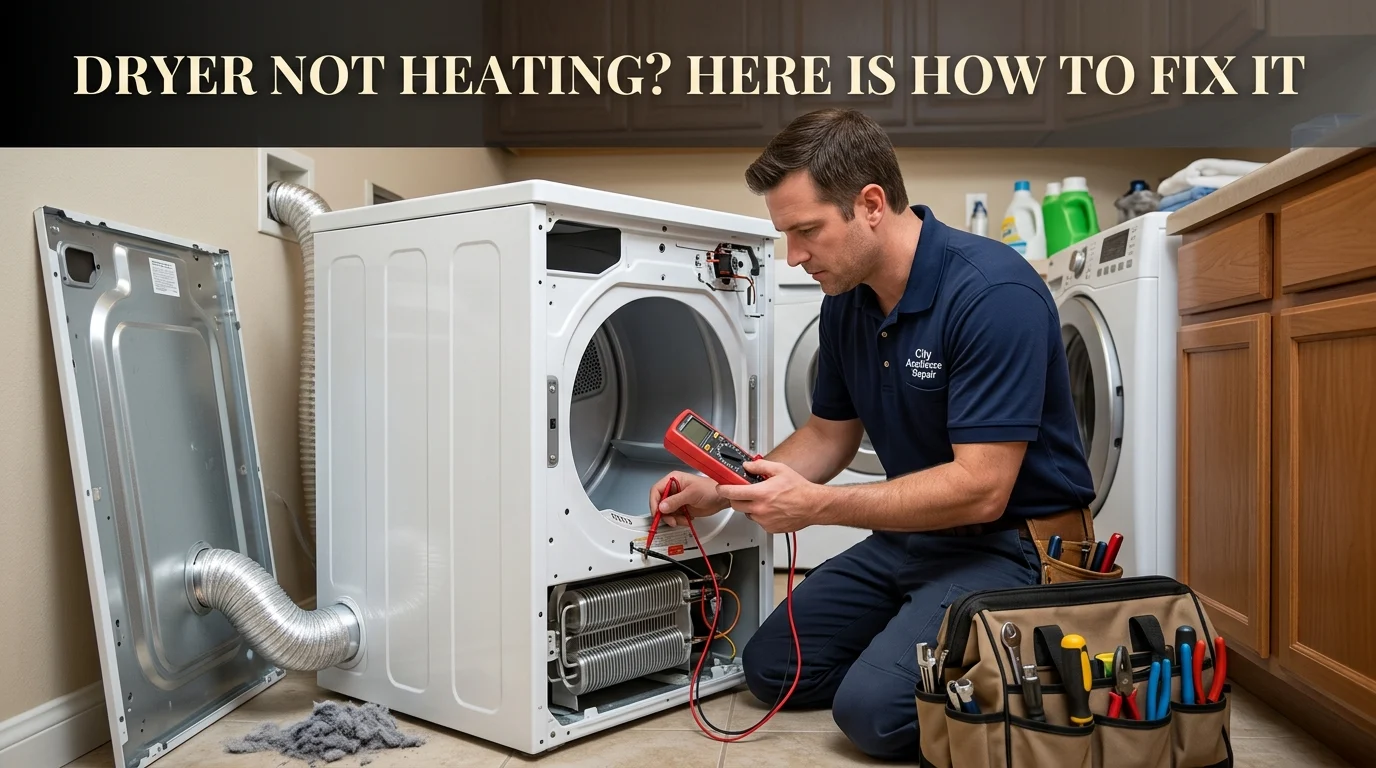
A dryer not heating is most often caused by a tripped breaker, a closed gas valve, a blown thermal fuse, or a worn out heating element. The drum can keep spinning even when none of these parts are working, which is why the dryer feels like it runs fine but leaves your clothes damp and cold.
If your dryer runs but will not heat, check the cycle setting first, then the circuit breaker or gas valve, then the lint screen and vent. If those are fine, the thermal fuse or heating element has likely failed. Electric dryers need two working circuits to heat. Gas dryers need an open valve and a working igniter.
Below is a full walkthrough that covers electric dryers, gas dryers, symptom specific problems, and the most common brand differences, so you can find your exact issue without guessing.
Why Does a Dryer Stop Heating?
A dryer’s drum motor and its heating system run on separate parts. That means the drum can tumble normally while the heating side fails completely. Once you understand this, dryer not heating problems become much easier to sort through.
The most common causes, in the order most repair technicians check them, are:
- A cycle set to Air Fluff or No Heat instead of a heat setting
- A tripped circuit breaker, on electric models
- A closed gas supply valve, on gas models
- A clogged lint screen or blocked exhaust vent
- A blown thermal fuse
- A failed heating element or gas igniter
- A bad thermostat, timer, or control board
Check These Things First
Before opening any panel, run through this short list. Many dryer not heating cases turn out to be something simple.
- Confirm the dryer is set to a heat cycle, not Air Fluff, No Heat, or Timed Dry with heat turned off.
- Check your home’s breaker panel. Electric dryers use two breakers, one for the motor and one for the heater. If only one trips, the drum still spins but produces no heat.
- For gas dryers, check the shutoff valve on the gas line behind the dryer. Turn it so the handle runs parallel to the pipe, not across it.
- Pull out the lint screen and clean it completely. A packed screen restricts airflow and can trigger a safety shutoff on some models.
- Look behind the dryer and make sure the exhaust hose is not crushed, kinked, or disconnected.
If the dryer still will not heat after these checks, move on to the electric or gas specific steps below.
Electric Dryer Not Heating
Electric dryers need two separate 120 volt circuits, which together supply the 240 volts the heating element needs. If one circuit fails, the motor keeps running but the heater gets no power. This is the single most common reason an electric dryer runs but stays cold.
Work through these checks in order:
- Both circuit breakers: Reset both breakers fully off, then fully on. A half tripped breaker can be easy to miss.
- The outlet voltage: If you’re comfortable with a multimeter, measure across the outlet’s terminals. You should read about 240 volts total. A reading closer to 120 volts points to a lost leg of power, which needs an electrician.
- The thermal fuse: This safety part cuts power to the heater permanently once it blows, usually because of restricted airflow. It cannot be reset. It has to be replaced. You’ll find it near the blower housing or on the heater duct.
- The heating element: Electric dryers use a coiled heating element to warm the air. Over time these coils can break. Testing it requires a multimeter and access to the back panel, so many people choose to call a technician at this step.
- The cycling thermostat: This part switches the heater on and off to hold a steady temperature. If it fails to open, the dryer may never heat at all.
Gas Dryer Not Heating
Gas dryers use a burner instead of an electric coil, so the failure points are different, but the drum will still spin normally even if the burner never lights.
- The gas supply valve: Confirm it’s fully open. A valve that’s even partly closed can let gas trickle through without giving the igniter enough to light.
- The igniter: This is one of the most common failure points in a gas dryer. When it cracks or burns out, it cannot get hot enough to ignite the gas, so the dryer tumbles with no heat at all.
- The gas valve solenoids: These small coils open the gas valve once the igniter glows. If they fail, you may notice the igniter glowing but no flame ever appears, or the dryer heating for a few minutes before it stops.
- The flame sensor: If this part is dirty or faulty, it can shut the gas off almost as soon as it lights, which can feel like the dryer never heated at all.
- The thermal fuse: Just like electric models, gas dryers have a thermal fuse that can blow from restricted airflow and permanently cut power to the heating circuit.
Dryer Runs But Won’t Heat: Match Your Exact Symptom
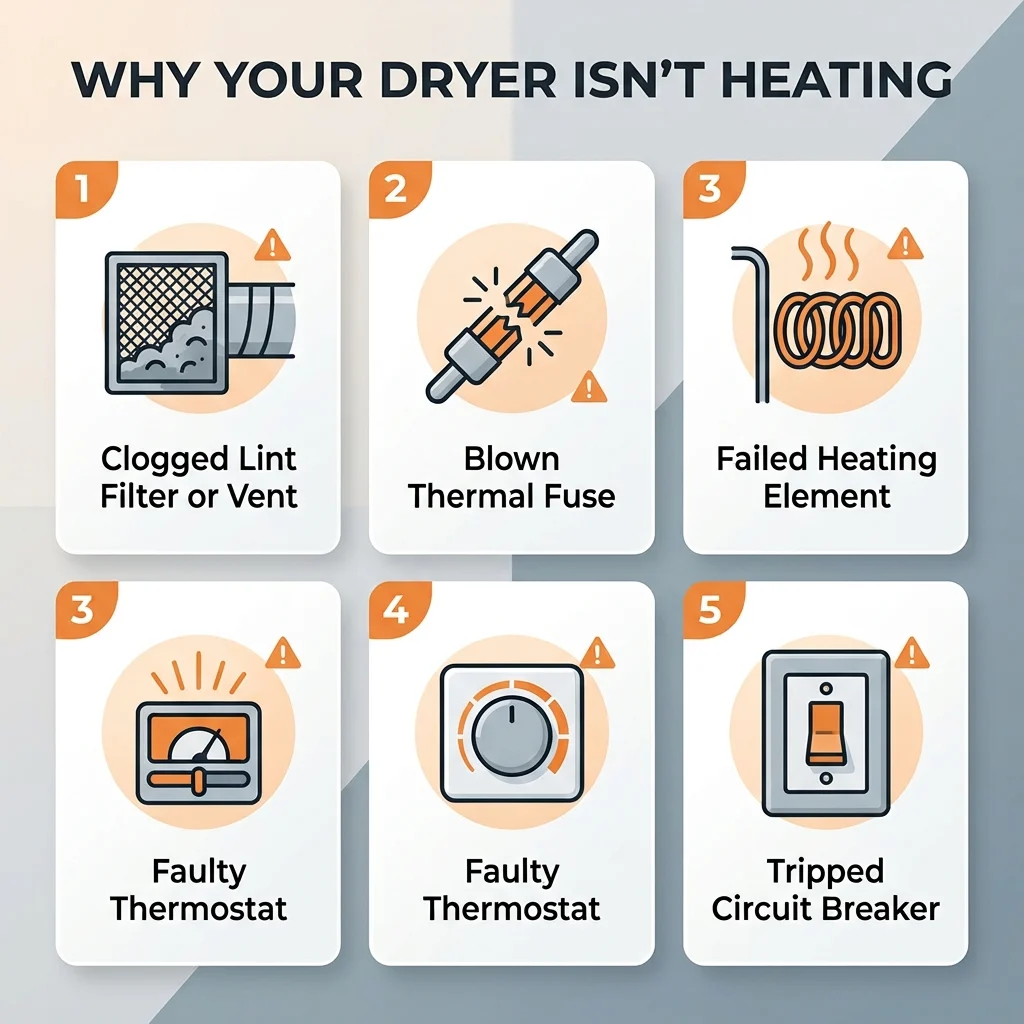
Not every dryer not heating problem looks the same. These specific patterns usually point to a specific part.
Dryer heats for a while, then stops
This pattern often points to a clogged vent causing overheating, which trips the thermal fuse partway through the cycle. Clean the vent fully before replacing any parts.
Dryer spins but blows cold air the entire time
This usually means the heating element or gas igniter never activated at all. Check power or gas supply first, then the element or igniter.
Dryer heats but clothes still come out damp
If you can feel real heat, the heating system is likely fine. The cause is probably airflow, an overloaded drum, or clothes that were too wet going in from the washer.
Dryer heats but the drum won’t turn
This is the opposite problem, tied to the belt, motor, or drive system rather than the heater. It’s worth knowing the difference so you don’t replace the wrong part.
Does This Differ by Brand?
The core parts, thermal fuse, heating element or igniter, thermostat, and circuit breaker, work the same way across nearly every brand. A few brands have small differences worth knowing.
| Brand | Common note |
| Samsung | Many models run a self check cycle and may show an error code pointing to the heater or sensor |
| Whirlpool and Maytag | Share parts and design in many models since Maytag is owned by Whirlpool |
| LG | Often flags airflow blockage through an Installation Test or error code before you even open the machine |
| GE | Straightforward layout, thermal fuse and element are usually accessible from the rear panel |
| Kenmore | Sold under several manufacturers, so the actual parts depend on who built your specific model |
| Amana | Simpler control systems, so a tripped breaker or blown fuse is the most likely cause |
What About the Reset Button?
Many people search for a dryer reset button, but most residential dryers do not have one true reset button for heating problems. What actually happens on most models is a breaker reset, unplugging the dryer for a minute, or in some newer models holding down the start button to clear an error code. If your specific model has a listed reset procedure in its manual, that is separate from fixing an actual failed part like a thermal fuse or heating element.
When to Call a Professional
Some steps are safe to do yourself, like checking settings, resetting breakers, opening the gas valve, and cleaning the lint screen and vent. Testing or replacing a thermal fuse, heating element, igniter, or thermostat means opening the cabinet and working near electrical or gas components. If you’re not comfortable with a multimeter or you have a gas dryer, it’s worth calling a licensed technician rather than guessing.
How to Stop This From Happening Again
- Clean the lint screen after every single load.
- Have the exhaust vent professionally cleaned once a year, or more often if your dryer runs daily.
- Avoid overloading the drum, since a packed load restricts airflow and stresses the heating system.
- Don’t load soaking wet items straight from a washer that isn’t spinning them out properly.
Frequently Asked Questions
Why is my dryer running but not heating up?
This usually means the drum motor is working but the heating circuit is not. Common causes include a tripped breaker, a closed gas valve, a blown thermal fuse, or a failed heating element or igniter.
How do I fix a dryer without heat?
Start with the cycle setting, then check the breaker or gas valve, then clean the lint screen and vent. If the dryer still won’t heat, the thermal fuse or heating element usually needs to be tested with a multimeter or replaced.
Why is my dryer taking two hours to dry clothes?
Long dry times are almost always an airflow problem rather than a heating problem. Check the lint screen and the full length of the exhaust vent for blockages before assuming a part has failed.
Why is my dryer blowing cold air?
Cold air with no heat at all points to the heating element or gas igniter never activating. Check your power supply or gas valve first, since a lost circuit or closed valve produces the exact same symptom.
Is a bad plug or a bad heating element more likely if my dryer runs but doesn’t heat?
Check the plug and breaker first since they are easier and safer to test. If both check out fine, a failed heating element becomes the more likely cause.
Why won’t my gas dryer heat up?
A gas dryer wont heat up when the igniter, flame sensor, or gas valve coils fail, and a tripped thermal fuse can also cut the heat. These parts sit behind the drum and need a multimeter to test safely.
How do I repair a gas dryer that has no heat?
To repair a gas dryer that has no heat, a technician tests the igniter, the flame sensor, the gas valve coils, and the thermal fuse in order, then replaces the failed part. A heating element not working on dryer models is the electric version of the same problem, checked the same careful way.
This guide is for general troubleshooting only. Working near electrical panels or gas lines carries real risk. If you are not confident performing a step safely, contact a licensed appliance technician.